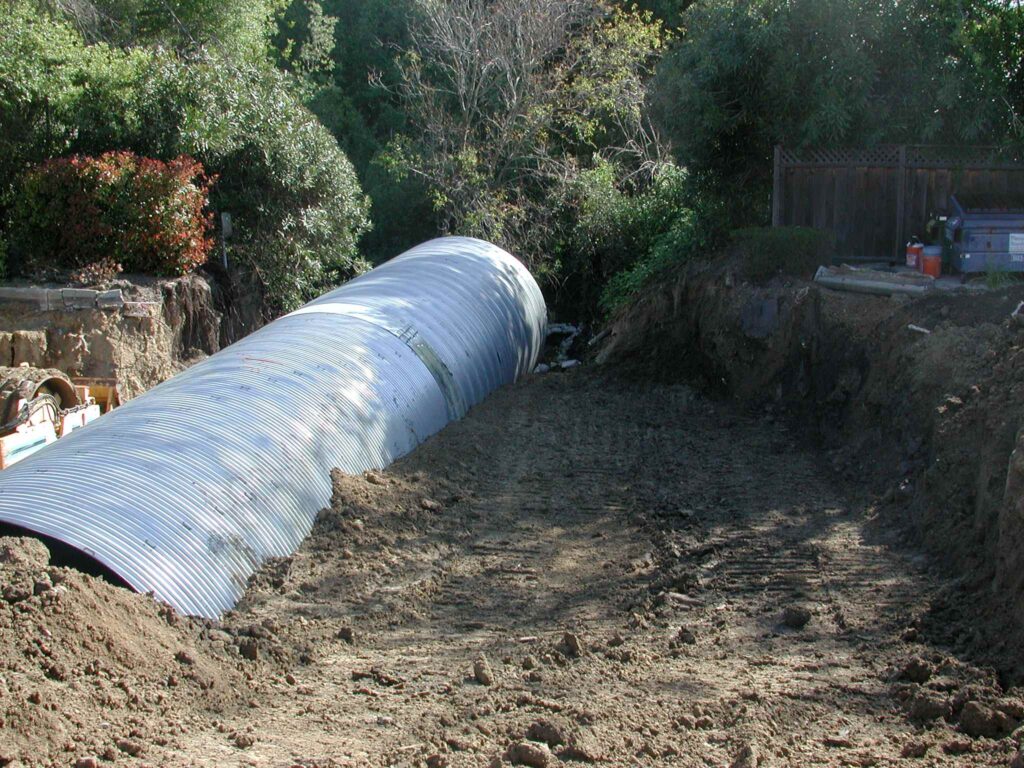
erosion control services Alameda When you look at a large drainage culvert installation, like the kind shown in the featured image, most of the work is happening before the pipe ever gets covered. The trench has to be cut to the right depth, the bottom has to be shaped and compacted, and the pipe has to be set so water moves where it is supposed to go. In Alameda, CA, where winter storms, flat grades, older drainage layouts, and bay-area soils can all affect runoff, erosion control starts with understanding how water moves across the site.
What a culvert does on a drainage & erosion control job
A culvert is a pipe or box structure that carries water under a driveway, access road, pathway, berm, or low crossing. Instead of letting runoff spread across bare soil and cut its own channel, the culvert gives that water a controlled route. On a larger job, crews excavate a trench, place bedding material, set the pipe at the correct slope, backfill around it in lifts, and protect the inlet and outlet so fast-moving water does not scour the ground away.
That may sound simple, but small mistakes can create big problems. If the culvert is too small, heavy rain can back up and flood the area upstream. If the pipe is set too flat, sediment settles inside and slowly blocks flow. If it is too steep, water can shoot out the end and tear into the soil. If the trench is not compacted correctly, the pipe can settle, crack, or shift. Good erosion control services Alameda property owners rely on are tied closely to careful excavation, grading, and stormwater planning.
Why proper grading and trench excavation matter
The pipe is only one part of the drainage system. The grade around it decides whether water enters the culvert cleanly or bypasses it and keeps washing across the surface. During trench excavation, the crew needs to follow the planned flow line, account for existing utilities, keep the trench stable, and prepare a solid base under the pipe. Bedding material helps support the culvert evenly, which matters when soil is wet or when vehicles may pass over the crossing.
Alameda sites can have tight access, nearby pavement, mature landscaping, utility lines, and limited fall from one side of the property to the other. That means drainage improvements have to be laid out with care. Sometimes the job needs a culvert and a swale. Sometimes it needs area drains, riprap, a catch basin, or temporary erosion controls while the excavation is open. The goal is not just to move water away from one spot. The goal is to move it safely without causing a new problem downstream.
Without runoff control, erosion often starts small. You may see a shallow groove in a gravel drive, a muddy fan of sediment at the curb, soil pulling away from a slope, or water cutting along the edge of pavement. After a few storms, that small groove can become a channel. Once water finds a weak path, it usually keeps using it. That is why culvert installation, stormwater management, and erosion prevention should be planned together rather than treated as separate tasks.
Common signs your site may need runoff control
Watch what happens during and right after a heavy rain. Standing water, washed-out gravel, exposed roots, soft shoulders along a drive, sediment collecting near drains, or water flowing across areas where people or vehicles need access are all warning signs. On sloped ground, even a modest grade can send enough runoff downhill to damage soil. On flatter Alameda properties, poor drainage can leave water sitting too long, which weakens subgrade, damages surfaces, and makes maintenance harder.
A well-planned culvert installation usually starts with a site walk. The contractor looks at where water comes from, where it should go, how much area drains to that point, what soil conditions are present, and whether the discharge point can handle the flow. From there, pipe size, pipe material, trench depth, inlet protection, outlet protection, and backfill method can be selected. Corrugated HDPE, reinforced concrete pipe, and other culvert materials all have their place, but the right choice depends on load, cover depth, flow needs, and site conditions.
Once the culvert is installed, the finish work matters just as much as the trench work. Inlets may need rock, headwalls, or grading that guides water into the pipe. Outlets may need riprap or an apron to slow water down and prevent scour. Disturbed soil should be stabilized so the next rain does not carry it away. When drainage solutions in Alameda are built with the whole site in mind, the finished system should be quiet, steady, and easy to maintain. Good erosion control is not about making water disappear. It is about giving storm runoff a safe path before it has a chance to cause damage.
Learn more on our website home page, and see additional guidance from HUD.
erosion control services Alameda can be worth exploring based on your goals, budget, timing, and the type of service or product you actually need.
erosion control services Alameda is worth comparing carefully before making a final decision about the right provider, service, or product.
For more helpful reading, see our erosion control services Alameda article guide.
Ready to take the next step? Request your free consultation on our estimate page and see how Erosion Control Alameda can help to find the perfect solution for your needs.